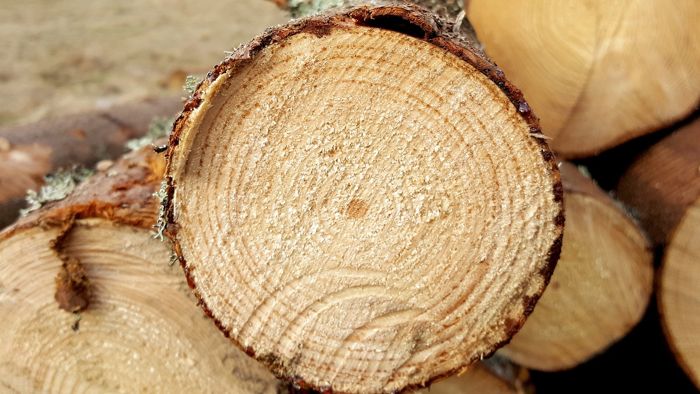
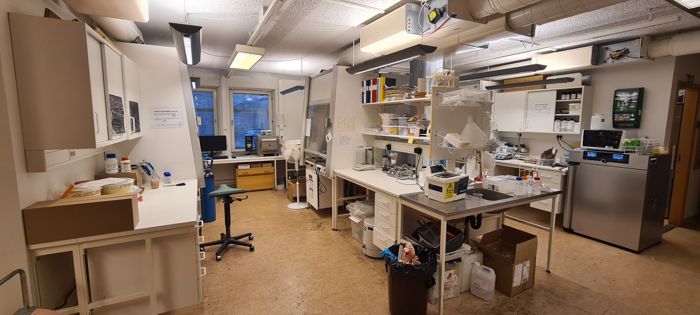
Illustration: Johanna Gudmundsson

Wood Technology

The research at LTU Division of Wood Science and Technology can be summarised as the right piece of wood in the right place using new measurement technology, advanced information processing and wood communication from felling to finished product.
Our research covers wood scanning technology, wood machining and wood production systems including studies of the connections between different links in the forestry-wood chain.

We have more than 20 years experience from CT-scanning of wood which means that we are world leading in this field. Our old CT-scanner has been worn out so a new one was installed in August 2008. LTU has also developed an industrial X-ray LogScanner that now is used on about 15 sawmills throughout Europe. For this work Anders Grönlund, Johan Oja and Stig Grundberg were awarded Schweighofer Prize 2007.

We have very close cooperation with SP-Trätek in Skellefteå, together we have a world leading competence in wood scanning and sawmill production technology.

Wood Production Technology

The research in the wood production area is aiming at developing methods and techniques for optimized utilization of the raw material. We are in this work using tools such as different statistical methods, simulation techniques, computer tomography for scanning of internal properties in logs and scanning of wooden surfaces with camera techniques.

 How people’s preferences for different aesthetic features on visible wooden surfaces affect the connections between the different links in the wood value chain is also a research topic in our group.

Wood Machining

Our research in the wood machining area is mainly aiming at decreasing the share of saw dust in the primary disintegration in sawmills. The research includes fundamental studies regarding chip formation and cutting forces but also industrial experiments at sawmills. We are using tools such as finite element simulations and high speed photography.

Gluing without glue

Gluing without glue is a rather new research area in our group. The driving forces for this new technology are environmental concerns and cost saving as the cost for glue can be avoided. We are in our research mainly studying how different process parameters affect the “glue-line” performance.


Contact

Professor Anders Grönlund

Department of Engineering Sciences and Mathematics

Page Editor and Contact: Kersti Bergkvist

Published: 30 March 2011

Luleå University of Technology