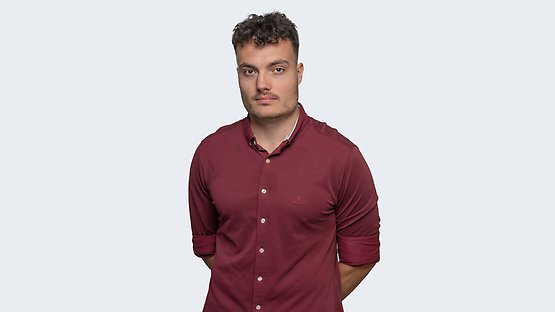
Vedad Coric
Vedad Coric
Doctoral Student
Research subject: Structural Engineering
Division: Structural and Fire Engineering
Department of Civil, Environmental and Natural Resources Engineering
-
Luleå, T2205
About me
My career sits at the crossroads of computer science and civil engineering, with a focus on advancing how we monitor and maintain critical infrastructure. I am currently a PhD student at Luleå University of Technology, where I lead the department’s Digital Bridges initiative. My research centers on Structural Health Monitoring (SHM), and I specialize in building a holistic understanding of structural integrity by fusing direct, in-situ sensing with indirect monitoring techniques using techniques such as "drive-by monitoring", UAV inspection and computer vision.
My journey began in early 2024 as a Research Engineer at LTU, an experience that provided me with a strong foundation in both Non-Destructive Testing (NDT) and Destructive Testing (DT). Since then, I have contributed as a systems engineer and data analyst to major projects such as the Trough Bridge Project, Kiruna Hospital project, and Haparanda Rail Project. These roles allowed me to gain hands-on experience with a wide array of scientific measurement equipment, including Fiber Optics, Strain Gauges, FBG sensors, LVDTs, and advanced Digital Image Correlation (DIC) systems, to analyze and predict structural behavior. To ensure my research has a real-world impact, I actively engage with industry partners and have presented my findings at industrial invitations. I also delivered a 1-hour webinar on multilevel SHM principles that has been developed together with industry insight.
My academic background in computer science—earned at Umeå University and the Technical University of Munich—paired with formative experiences on innovative teams at Google and BMW, has shaped my approach to research. I believe that persistence and curiosity drive meaningful progress, and I am dedicated to turning multi-disciplinary research into reliable, practical solutions that help safeguard our built environment.
Research interests
At Luleå University of Technology I focus on weaving together structural engineering, data science and climate modelling to transform how we judge the health of ageing infrastructure. I combine diverse, high‑frequency streams—everything from embedded strain gauges and vibration arrays to drive‑by vehicle signatures, UAV photogrammetry and LiDAR point clouds—into unified, physics‑informed neural networks that can detect damage and forecast remaining life without hand‑labelled examples. By explicitly modelling temperature, moisture and freeze–thaw effects, these hybrid models reveal how a warming climate accelerates deterioration, enabling more reliable life‑cycle predictions. The goal is a decision pipeline that delivers real‑time, uncertainty‑aware insights to engineers in the field through augmented‑reality overlays, automated alerts and intuitive dashboards, ultimately guiding maintenance where it matters most.
My objectives
- Predict & assess structural health in real time by fusing multi‑scale, multi‑modal data and learning directly from physics‑guided, unsupervised models.
- Quantify environmental influence on deterioration to refine life‑cycle predictions under accelerating climate change.
- Deliver actionable insights to asset owners through high‑level dashboards, inspection tools and automated alerts.
- Demonstrate impact via extended monitoring campaigns on bridges and buildings, open‑source reference datasets, and continued industry outreach (webinars, invited talks).
Projects
- Climate Bridges - Bridge Resilience & Climate Effects - How is the climate change impacting the network of bridges?
- Digital Bridges Project - Advancing Bridge Management through AI, IoT, and Circular Economy Principles
- Trough Bridge Project
- Development of a proof loading method for railway bridges
- Kiruna Hospital Building
- Kiruna City - Mining movements induced damage on existing buildings
Updated:
Published: