
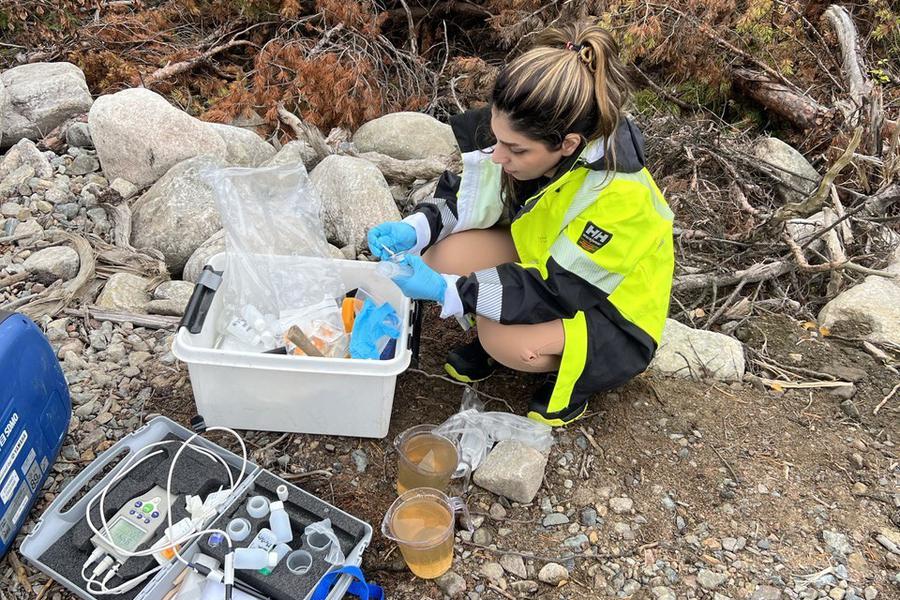
Sepideh Gholizadeh Khasevani has investigated how industrial residues can immobilise metals in contaminated soil and reduce the risk of their spread.
Idag
Industrial waste could help clean up contaminated land
Former industrial sites can contain metals that risk spreading into soil and water. Cleaning up these areas often involves substantial costs and transporting large quantities of contaminated soil. Researchers at Luleå University of Technology have investigated how residues from other industries can be used to immobilise contaminants in soil, potentially allowing treated soil to be safely reused.
“Instead of always excavating and transporting contaminated soil, we may in some cases be able to treat it on site. At the same time, we can make use of materials that would otherwise be considered waste,” says Sepideh Gholizadeh Khasevani, who conducted the research as a PhD student in Waste Science and Technology at Luleå University of Technology.
Ash and slag can replace cement
In the thesis Stabilization/Solidification of Metal-Contaminated Soil Using Residue-Based Binders: From Laboratory Performance to Field Applicability, she investigates how contaminated soil can be treated using residues from the energy and steel industries.
The method involves mixing ash and slag into the soil. As the mixture hardens, the treated soil gains mechanical strength while the metals are immobilised, making it more difficult for them to spread through water.
The research uses contaminated soil from the Näsudden area in northern Sweden. The results show that much of the cement can be replaced with bioash and that entirely cement-free mixtures using bioash and ground granulated blast furnace slag can achieve good mechanical strength and durability.
“By using industrial residues instead of cement, we can reduce the need for new raw materials while developing new ways to treat contaminated soil,” says Sepideh Gholizadeh Khasevani.
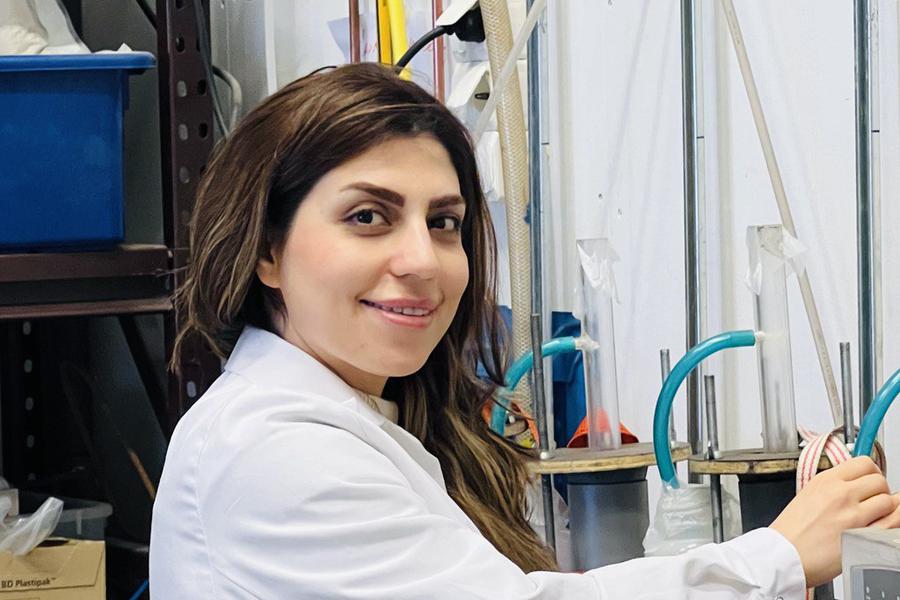
Sepideh Gholizadeh Khasevani conducted her research in Waste Science and Technology at Luleå University of Technology.
Different metals require different treatment
An important finding is that the same method does not work equally well for every contaminant. Some metals, including zinc and cadmium, could be effectively immobilised, while others, such as copper and arsenic, proved more difficult to control under certain chemical conditions.
The researchers therefore also investigated how activated carbon could improve treatment performance, particularly by reducing dissolved organic carbon and limiting the release of copper and nickel. The findings show that remediation methods need to be adapted to the contaminants present and the chemical properties of the soil.
“It is important to understand how different metals respond. A treatment that works well for one contaminant may not be equally effective for another,” she says.
Could reduce the need for transport
The research also includes a pilot-scale demonstration involving approximately 100 tonnes of contaminated soil, along with long-term laboratory testing and field monitoring. This is important because the treated material must remain stable when exposed to rainfall and other environmental conditions.
If contaminated soil can be treated on site, the need to transport large quantities of soil to landfill could be reduced. At the same time, industrial residues could find new applications.
“The aim is to develop methods that make it possible to manage contaminated soil safely while using society's resources more efficiently,” says Sepideh Gholizadeh Khasevani.
More information
Contact
Sepideh Gholizadeh Khasevani
- Doctoral student
- 0920-49
- sepideh.gholizadeh.khasevani@ltu.se
- Sepideh Gholizadeh Khasevani
Published:
Updated: