
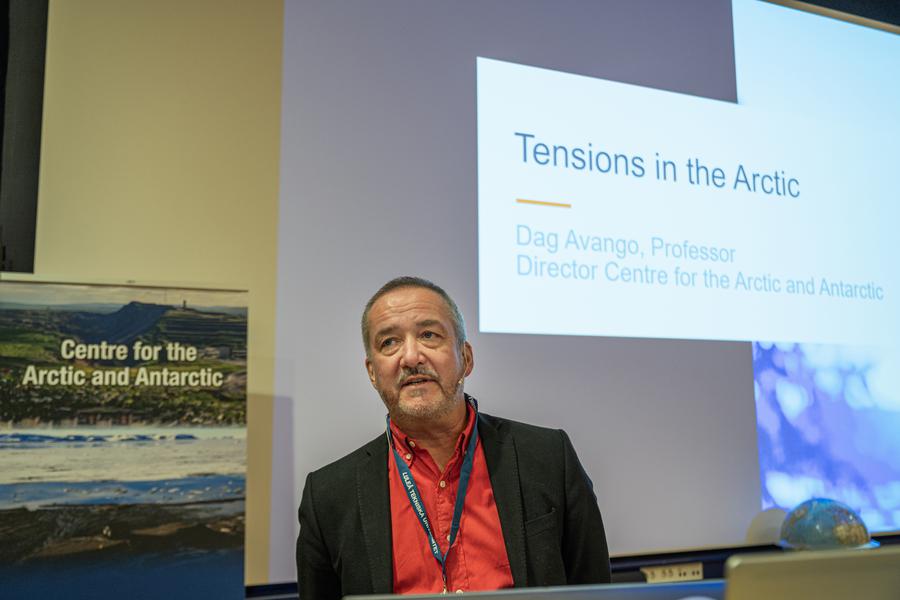
Dag Avango, Director of the Centre for Arctic and Antarctic.
29 October 2026
Space and the Arctic part of total defence
Campus Total Defence is a collaboration between 37 Swedish higher education institutions, with the aim of contributing knowledge and expertise to Sweden’s total defence. On 21–23 October, a symposium was held at Space Campus in Kiruna as part of Campus Total Defence’s area of expertise Space and the Arctic.
The symposium was opened by Dag Avango, Professor of History and Director of the Centre for Arctic and Antarctic at Luleå University of Technology, who leads the work on this area of expertise in Sweden.
He noted that security policy issues are increasingly in focus in various states’ strategies for the Arctic region. Canada’s, Sweden’s and the EU’s new Arctic strategies are examples of this. This is due to several global processes of change affecting the Arctic region. The most important is the deterioration of international relations as a result of Russia’s war in Ukraine, and the desire of non-Arctic states to exert influence in the Arctic, such as China, which describes itself as a near-Arctic state. Other important processes of change include climate change, which is progressing more rapidly in the Arctic and making shipping possible. Climate change is also contributing to increased global demand for the natural resources found in the Arctic, as well as growing interest in investing in industries linked to the green transition in the region.
“The developments are creating challenges at the global, national, regional and local levels. The Arctic region is therefore of central importance to Sweden’s total defence. The universities participating in Campus Total Defence can contribute research and education that can help address these challenges,” says Dag Avango.
René Laufer, Professor of Space Systems Engineering, described how the Russian satellite Kosmos 2612 has been tracking the satellite ICEYE–X36 over the past six months. On 18 October, the satellites were only 100–150 metres apart. ICEYE–X36 is a commercial, multinational satellite that, among other things, provides high-resolution radar images to Ukraine’s defence forces. The incident marks a milestone in the history of space: it is the first time it has been possible to prove that a military satellite has approached a civilian satellite without permission.
At the time of writing, there are no open sources proving that Kosmos 2612 has spied on or interfered with ICEYE–X36. However, espionage does occur. For example, a hostile satellite may approach another satellite to study how it is constructed. It may also intercept another satellite’s signals.
Robot arms destroying satellites
There are also several different methods for destroying a satellite or disabling its functions. A hostile satellite may collide with it, fire a weapon or destroy it using robotic arms. A missile can be launched from Earth towards the satellite. Laser beams or microwaves can be directed at the satellite to temporarily disrupt its sensors and cameras, or permanently destroy them, its solar panels or other vital components. An electromagnetic pulse can disrupt the satellite’s electronics. Another method is to temporarily overwhelm the signal between the satellite and another device (electronic jamming), or to send a false signal to the receiver (signal spoofing).
Satellites have a wide range of military applications, including camera surveillance of troop movements, communications, navigation and early missile detection. However, René Laufer pointed out that satellites are also of great importance to civilian society. They are used for financial transactions, mobile phone communications, weather forecasting, agriculture, monitoring forest fires, and navigation on land, at sea and in the air. Even a temporary disruption to satellite signals could therefore significantly destabilise essential societal functions.
Welfare crimes undermines trust
Amber Beckley, Associate Professor of Criminology at Örebro University, presented an ongoing research project on threats and crimes against critical infrastructure north of the Arctic Circle. She is conducting the project together with Kim Nilvall from the Swedish Police Authority. The critical infrastructure primarily comprises the mining industry, transport routes, space technology infrastructure, and energy and hydropower.
They note that there is no comprehensive picture of crime and threats in the polar region; information and data are fragmented across different government agencies, businesses and researchers. By integrating this scattered information with the Swedish Police’s crime statistics, they are seeking to develop a clearer situational picture of the region. Their research shows, among other things, that welfare fraud, such as benefit fraud, is more common north of the Arctic Circle than in the rest of Sweden. Welfare crime undermines trust in society, which may ultimately have a destabilising effect and therefore pose a security risk.
Anna Öhrwall Rönnbäck, Professor of Product Innovation and Chair of Aerospace Cluster Sweden (ACS), presented the organisation’s activities together with Olle Persson, ACS Northern Node Leader. ACS is a network for researchers, policymakers and businesses in the aerospace industry.
The Northern Node has a particular focus on space technology. With more than 70 member companies, ACS is a resource for developing and delivering aerospace technology solutions. Its members are spread across the country, and the companies and their employees constitute an important part of Sweden’s total defence.
The member companies range from innovative start-ups to specialised metal subcontractors, collectively representing advanced manufacturing, materials, product development and technological innovation.
By creating clusters in the aerospace sector, robust ecosystems are developed that increase companies’ resilience in times of crisis. Most of the innovations developed by ACS clusters have so-called dual-use applications, meaning they can be used for both civilian and military purposes.
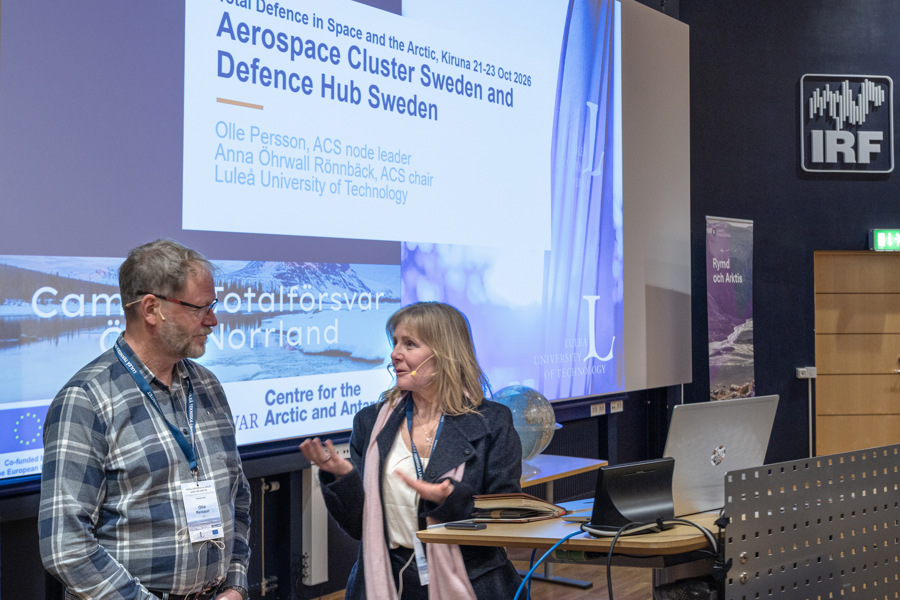
Anna Öhrwall Rönnbäck and Olle Persson from Aerospace Cluster Sweden.
Good potential for food security
According to Ove Karlsson of LTU Business, Norrbotten has very strong potential for food security. It would be entirely possible for the region to achieve 100 per cent self-sufficiency. The land is easy to cultivate, water resources are plentiful, and the warmer climate could contribute to increased productivity.
At present, however, Norrbotten has a deficit in almost all types of food relative to its population. To reverse these figures, the profitability of agriculture in Norrbotten needs to increase. Ove Karlsson argues that this requires developing the agricultural market and business management capabilities in the north. He calls for greater cooperation and the establishment of business clusters in the Arctic that take economic, social and ecological sustainability into account.
“I believe we can learn a great deal from the way Swedish Aerospace Cluster collaborates,” says Ove Karlsson.
Emanuele Tomassi and Rémi Blanchart, both doctoral students in space technology, spoke about the SMART 6GSAT research centre. By connecting satellites and terrestrial mobile networks using 6G technology, the networks will be able to function even in remote areas and during disruptions.
Campus Total Defence – Upper Norrland is a collaborative project between Luleå University of Technology and Umeå University. It builds on the geopolitically strategic location of Upper Norrland and its specific conditions, including its climate and population size. Jenny Jäger, Senior Lecturer in Physiotherapy and National Education Coordinator for Campus Total Defence, described her work on both regular education and commissioned training to strengthen preparedness. She emphasised the importance of collaboration: no single university in Sweden can provide expertise in every field on its own.
Project about Russian history falsification
Ulrika Eckersand from the Swedish Defence Research Agency (FOI) spoke about the agency’s work on the Arctic. Among other things, a collaborative project is underway on climate change and energy-related risks to NATO’s military forces in the region. Another project concerns how Russia distorts historical events as part of its hybrid warfare.
Christine Große and Simon Andersson are a Professor and a Researcher in Information Systems, respectively. Their presentation also focused on hybrid threats. They discussed, among other things, cognitive hacking, which refers to methods of manipulating people’s thoughts rather than hacking a computer program. Christine Große is leading an Arctic Six Chair project that explores how citizens’ resilience to information influence can be strengthened without simultaneously reducing trust in information provided by public authorities.
According to the Swedish Psychological Defence Agency, the Swedish election was not subjected to any major information attacks. However, Christine Große and Simon Andersson stressed the importance of remaining vigilant in the future. Among first-time voters, TikTok was the most important source of information for 48 per cent, compared with 23 per cent in 2022. The Swedish Psychological Defence Agency identifies the platform as particularly susceptible to cognitive hacking.
Not all threats to humanity are caused by humans. Mikael Granvik, Professor of Space Technology, explained the need for international cooperation to detect and deflect dangerous asteroid impacts. One way to protect Earth is to collide a spacecraft with an asteroid to alter its trajectory. This method has been successfully tested.
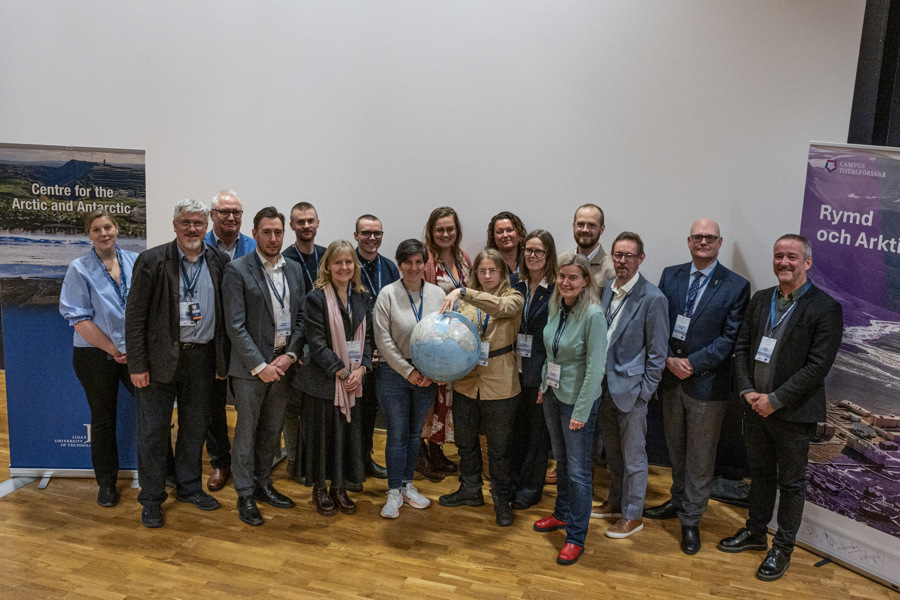
The participants in the symposion.
Refugee reception during World War II
Sara Hardselius presented her recently initiated doctoral research project in history. It examines how public authorities and civil society received refugees in northern Sweden during the Second World War, and what lessons can be drawn from these experiences.
Daniel Fjellborg holds a PhD in Political Science from Luleå University of Technology. He is a postdoctoral researcher at the University of Gothenburg and a teacher at Tornedalens Folk High School. He spoke about the Truth Commission for Tornedalians, Kvens and Lantalaiset, and the role of Tornedalens Folk High School in strengthening the minority’s identity and self-esteem. The minority’s geographical distribution covers an area spanning Sweden, Finland and Norway. Through its cross-border history, research on Tornedalians, Kvens and Lantalaiset can contribute important knowledge for understanding the conditions for total defence in the European Arctic.
“Anyone seeking to establish an operation in the region, such as mining, without sufficient knowledge of the history of assimilation policies risks fuelling conflicts and undermining trust in society,” says Daniel Fjellborg.
EISCAT (European Incoherent Scatter Scientific Association) is an international scientific organisation operating four research facilities north of the Arctic Circle. The organisation’s CEO, Philip Påhlsson, described how its research infrastructure can have both civilian and military applications, and how EISCAT navigates between civilian and military perspectives to ensure that its operations can continue.
Olle Norberg, Director General of the Swedish Institute of Space Physics (IRF), outlined the organisation’s views on total defence issues.
Unless otherwise stated, the people mentioned above are employed by Luleå University of Technology.
Related organisations and projects
Published:
Updated: