
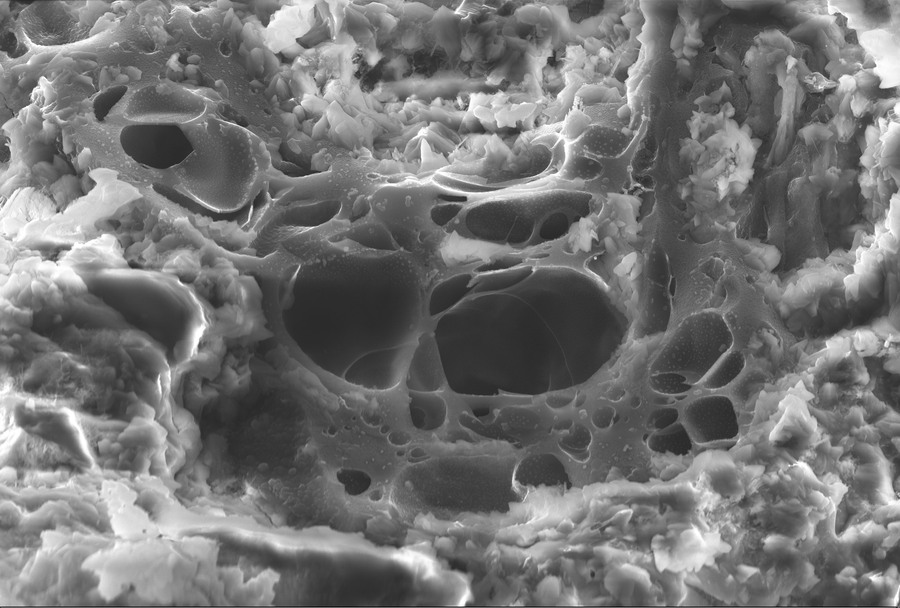
Biochar’s porous structure allows it to absorb and retain water, affecting the properties of concrete.
Igår
Biochar can reduce concrete’s carbon footprint, but more isn’t always better
Concrete’s large carbon footprint has increased the need for alternative materials. Researchers at Luleå University of Technology have investigated how biochar can be used to reduce emissions from concrete. The results show significant climate benefits, but also indicate that the amount of biochar needs to be adjusted so that the concrete retains important properties such as strength and fire resistance.
“Biochar has great potential to reduce concrete’s climate impact by sequestering carbon in a stable form. But the goal cannot be to use as much biochar as possible. We need to find a balance between climate impact and the material’s performance,” says Dong Wang, a doctoral student in fire engineering at Luleå University of Technology.
Carbon from biomass can be stored in concrete
In his dissertation, *Biochar for the Development of Low-Carbon Concrete*, Dong Wang investigates what happens when biochar is used to replace portions of the cement or sand in concrete.
Biochar is produced by heating biomass—such as wood or food production waste—with little or no access to oxygen. Some of the carbon that the plants previously absorbed from the atmosphere is then retained in a stable form and can be stored for a long time.
When biochar is incorporated into concrete, it can therefore have a dual effect: the amount of conventional raw materials can be reduced while carbon is stored within the material itself.
“Life cycle assessments show that when wood-based biochar replaced 20% of the cement’s volume, the concrete’s climate impact decreased by 42%. When biochar from fruit waste was used to replace sand, the climate benefit could be even greater. At high substitution rates, so much carbon was sequestered that certain mixtures had a negative carbon footprint,” says Dong Wang.
However, the mixtures that yield the greatest climate benefits are not necessarily the ones that perform best as building materials.
Biochar alters the properties of concrete
Biochar is highly porous and absorbs water. This means it behaves differently than ordinary cement and sand when mixed into concrete.
Dong Wang demonstrates, among other things, that how the substitution is calculated makes a significant difference. When cement was substituted based on volume rather than weight, the fresh concrete performed better. Furthermore, the EN standards for determining the water absorption of lightweight aggregate can be problematic when applied to highly porous biochar aggregate.
Highly porous biochar can retain water, which can be advantageous. The water can be gradually released within the concrete and contribute to the cement’s continued hardening. At the highest sand replacement ratio, shrinkage after 28 days was 65% lower than in conventional concrete.
“The porosity of biochar presents challenges, but it can also provide properties that we can take advantage of. That’s why we need to understand the material rather than simply viewing it as a direct substitute for cement or sand,” says Dong Wang.
Climate benefits and strength must be balanced against each other
At the same time, the results clearly show why more biochar does not automatically mean better concrete. When larger amounts of cement or sand were replaced, the compressive strength decreased. When wood-based biochar replaced 20% of the cement’s volume, the strength after 56 days was 13% lower than that of the reference concrete. When a very high proportion of sand was replaced, the decrease was significantly greater.
This means that it is not enough to compare different concrete mixes based solely on how much carbon dioxide they can save or store. The material must also meet the requirements of the structure in which it will be used.
“The option with the greatest climate benefit is not necessarily the best solution. Concrete must also have the right strength and perform throughout its entire service life,” says Dong Wang.

Dong Wang, doctoral student in Fire Technology at Luleå University of Technology.
Fire resistance also changes
Since concrete is used in buildings and other structures, the material must also withstand extreme conditions. Dong Wang has therefore investigated what happens to biochar concrete when it is exposed to temperatures of 400 and 800 degrees.
The results show that biochar affects heat transfer through concrete. The intended purpose of adding biochar is important. Using biochar powder as a substitute for cement has only a minor effect, while using biochar aggregate as a substitute for sand reduces the concrete’s thermal conductivity. At high biochar concentrations, temperature differences within the material increase, which could potentially contribute to greater thermal damage. This increased thermal damage may even counteract the benefits of accelerated cement hydration during heating.
Fire resistance therefore becomes another factor to consider when determining the amount of biochar to use. A mix that results in very low climate emissions must still be able to meet the safety requirements applicable to its intended use.
“If new materials are to be used in buildings, we need to understand how they behave even in the event of a fire. Climate performance and fire safety cannot be treated as two separate issues,” says Dong Wang.
The Right Amount for the Right Application
The dissertation thus demonstrates both the potential and the limitations of biochar in concrete. The results do not point to a single formula where as much biochar as possible should be added, but rather indicate that the amount and type of biochar need to be adapted to the intended use of the concrete.
For the construction industry, this means better opportunities to assess where biochar can actually deliver significant climate benefits without compromising important material properties.
“Biochar can be a tool for developing concrete with a significantly lower climate impact. But to use it in practice, we need to optimize the entire material and find the right balance between climate benefits, strength, and safety,” says Dong Wang.
Contact
Dong Wang
- Doctoral Student
- 0920-493446
- dong.wang@ltu.se
- Dong Wang
Published:
Updated: