
Igår
Canadian-Nordic cooperation in the Arctic
The changing geopolitical situation in the Arctic means that the Nordic countries and Canada need to establish new connections with one another. Within the framework of The Arctic Six, a workshop on Nordic–Canadian university cooperation was held at Nord University in Bodø in mid-October.
“The Nordic and Canadian universities share many opportunities and challenges, not least those related to the green transition, climate change and developments in the Arctic. At a time when the security situation in the region is becoming increasingly complex, international cooperation and knowledge exchange are more important than ever. By strengthening our cooperation, we can combine our knowledge and experience, develop new solutions and work together to contribute to a sustainable, secure and attractive future for people and communities in the Arctic,” says Vice-Chancellor Birgitta Bergvall-Kåreborn.
One of the workshop's main objectives was to identify new long-term platforms for cooperation in research, innovation and education. Researchers from Norway, Sweden, Finland and Canada discussed issues including defence, the extraction of critical minerals, resource development, Indigenous knowledge, the environment, Arctic communities, renewable energy and energy security.
The Ambassador welcomes cooperation
Amy Baker, Canada's Ambassador to Norway, emphasised that the strained geopolitical situation increases the need for cooperation between the countries.
“There is a natural partnership between Canada, Norway, Sweden and Finland. We are all part of the Arctic and share common values. Our strategic position in the north has made us more vulnerable. We must therefore do what we can to work together to maintain security and sustainable development in the Arctic,” says Amy Baker.
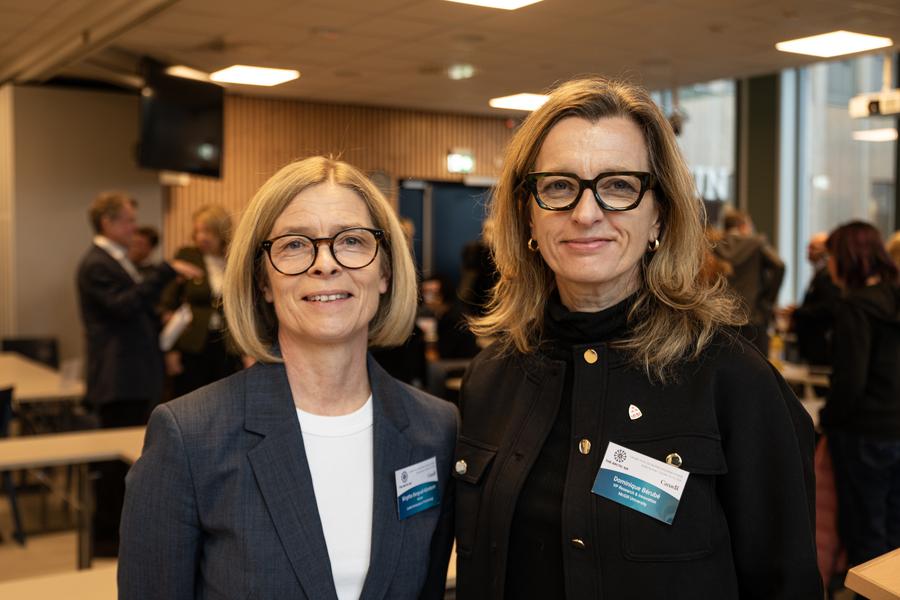
One of the Canadian academics who participated in the workshop was Dominique Bérubé, Vice-President of Research and Innovation at McGill University in Montreal. She visited Luleå University of Technology last spring and shares the ambassador's view of the global situation. She believes that Canada cannot put all its eggs in one basket.
“There is a risk that we will lose some of our collaborations with the United States because of the geopolitical situation. We therefore need to build a more diversified network,” says Dominique Bérubé.
Canada new member in Horizon Europe
Canada recently became an associated member of Horizon Europe. McGill University is therefore interested in learning more about how a country such as Sweden navigates the Horizon framework. Dominique Bérubé sees considerable potential for closer cooperation with Sweden and Luleå University of Technology.
“It was interesting to see how close the relationship is between Swedish universities and the business sector. We do not have the same tradition in Canada. Sweden's AI development and the establishment of a defence ecosystem are very promising. I see great opportunities for cooperation between our two countries here.”
McGill University is responsible for medical research and education, as well as access to healthcare, across 63 per cent of Quebec's territory, covering a population of 1.9 million. Dominique Bérubé believes that medical research, particularly research related to the Arctic and Indigenous health, could become a future area of cooperation between McGill and the Arctic Six universities.
“McGill can contribute research capacity. We are a large university and are ranked 30th in the world in the QS World University Rankings.”
The proposed budget for the next EU Horizon Europe Framework Programme for Research and Innovation is set to double for the 2028–2034 period, bringing the total to EUR 175 billion. Linda Solstrand Dahlberg, Senior Adviser to UiT The Arctic University of Norway in Brussels, says that the EU has adopted new political priorities, which are also affecting Horizon Europe.
EU invests in the Arctic
“We can see that the EU is investing in the Arctic at the moment, and the Union is an important player when it comes to funding Arctic research. The call for proposals on an ice-free Arctic is an excellent opportunity for cooperation between Arctic Six and Canada in particular. I believe that our universities can make a strong contribution because we have thematic expertise, capacity and competence in Arctic research,” says Linda Solstrand Dahlberg.
Ketih Larson from Umeå University leads The Arctic Six research group. Among other things, this means that he is responsible for The Arctic Six Chairs, a research programme open to senior researchers at The Arctic Six member universities.
“The momentum for cooperation between Canadian universities and the universities in Arctic Six is currently very strong. If we look at how Arctic Six has developed over the years, we have become far more specific and concrete. But we have realised that we need to do more. If the Chair programmes are to succeed in Horizon projects, we cannot cooperate only internally. We must also work with other strong institutions that have a clear Arctic profile,” says Keith Larson.
About The Arctic Six
The Arctic Six is a collaboration between Luleå University of Technology, Umeå University, Nord University, UiT The Arctic University of Norway, the University of Lapland and the University of Oulu. Together, the universities have more than 10,000 researchers and 100,000 students. The Arctic Six is a regional centre of UArctic. It is mentioned as one of eight key regional cooperation partners, including UArctic, in the European Commission's new Arctic strategy. Luleå University of Technology's membership in The Arctic Six is coordinated by the Centre for Arctic and Antarctic Studies, headed by Dag Avango.
The Nordic–Canadian meeting was followed by The Arctic Six's annual forum, which this year focused on The Arctic Six Chairs.
- The Arctic Six Forum 2026
- The Arctic Six Chairs at Luleå University of Technology
- The Arctic Six Chairs at the University of Oulu
- The Arctic Six Chairs at UiT The Arctic University of Norway
- A complete list of the 2026 Arctic Six Chairs
- Centre for Arctic and Antarctic
- The European Commission's Arctic strategy
Contact
Dag Avango
- Professor and Head of Subject
- 0920-491573
- dag.avango@ltu.se
- Dag Avango
Published:
Updated: