

Fredrik Sandin
Professor
Research subject: Machine Learning
Division: Embedded Intelligent Systems LAB
Department of Computer Science, Electrical and Space Engineering
About
I'm a physicist interested in the principles of cognition and how brain-like neuromorphic technologies External link. can be used to improve the efficiency and performance of sensors (machine perception) and artificial intelligence (AI) from edge to cloud: Google scholar External link., Linked In External link., LTU Machine Learning External link..
Contact
If you have an urgent matter please phone me from a number where I can reach you. To initiate contact please book a meeting here External link. or via the LTU staff calendar. I am unable to attend to all email messages.
Research
We work in both challenge-driven applied and basic research projects where machine learning, artificial intelligence and computational physics are used to solve challenging problems, often in cooperation with research institutes and industry.
For example, we are working on co-design optimization of sparse sampling and neuromorphic–digital sensor systems, such as sensors for intelligent fault diagnosis (IFD) and future high-energy physics (HEP) detectors. Another focus area is seamless integration of neuromorphic systems in the digital infrastructure, including addressing challenging problems such as dynamic service data interoperability and distributed processing of information where it is most efficient. We are also working on conventional deep learning projects, such as industrial chatbots External link. for agent-based decision support, and deep learning in edge devices (sparse sampling, online learning, few parameters, etc). Active projects:
- Fast, Robust, and Efficient NanoPhotonic Neuromorphic Computing (WASP-WISE, LiU-2023-00139 External link.), with NanoLund External link..
- Hybrid Digital-Neuromorphic Computing Services: Interoperability, Interfacing and Programming (Vinnova, 2023-01363 External link.), with RISE External link..
- Differential Optimization of Hybrid Neuromorphic-Digital Systems for Energy-Efficient Machine Learning (Jubileumsfonden och Kempestiftelserna, JCSMKJF23-0003 External link.), with TVM External link. and INFN External link. in Padova.
- Two postdoc projects, one funded by Creaternity External link. and one by Kempestiftelserna (JCSMK23-0218).
The present deep learning approach is resource intensive External link. and hence exclusive. Digital analytics works well in high-fidelity problem spaces, but is too power intensive for perception and cognition in noisy environments. The integration of complementary approaches like neuromorphic computing, nanophotonic computing and sub-Nyquist analog analytics is required for the long-term welfare of society in the era of AI External link.. For general motivations of this viewpoint see for example this External link. and this External link. report.
Completed research projects/contributions include:
- Vinnova VALD (FFI, dnr 2021-05035, 3.4 MSEK), KnowIT Fast External link. (PiiA, dnr 2019-02533, 4.6 MSEK). ALDEE (FFI, dnr 2019-03073, 3.5 MSEK), MetMaskin (dnr 2018-02666, 4.7 MSEK).
- EU ITEA3 AutoDC (dnr 2018-02232, 58 MSEK), ECSEL JU Arrowhead Tools (no 826452, 84 MEUR).
- The Kempe Foundations NCS (dnr SMK-1429 and JCK-1809, 4.4 MSEK).
- STINT Institutional Grant (dnr IG2011-2025, 1.5 MSEK).
Active PhD students:
- Karl Löwenmark External link., technical language supervision for intelligent fault diagnosis, GPTech External link..
- Rickard Brännvall External link. (RISE External link.), homomorphic encryption machine learning, worked in AutoDC External link..
- Co-supervision of Saleha Javed External link., Awais Khan External link. (joint PhD with Tommaso Dorigo External link.), and Lars-Johan Sandström External link..
Graduated PhD students:
- Carl Borngrund (2024), Towards Deep-learning-based Autonomous Navigation in the Short-loading Cycle (thesis External link., co-supervisor).
- Gustav Grund Pihlgren (2023), Deep Perceptual Loss and Similarity (thesis External link., co-supervisor).
- Mattias Nilsson (2023), Event-Driven Architectures for Heterogeneous Neuromorphic Computing Systems (PI, thesis External link.).
- Muhammad Ahmer (2023), Intelligent fault diagnosis and predictive maintenance for a bearing ring grinder, (thesis External link., co-supervisor, industrial PhD at SKF).
- Jacob Nilsson (2022), Machine Learning Concepts for Service Data Interoperability (PI, thesis External link.).
- Kim Albertsson (2021), Machine Learning in High-Energy Physics: Displaced Event Detection and Developments in ROOT/TMVA (thesis External link., CERN funded, in collaboration with Andreas Hoecker External link.).
- Siddharth Dadhich (2018), Automation of Wheel-Loaders (thesis External link., co-supervisor).
- Sergio Martin del Campo Barraza (2017), Unsupervised feature learning applied to condition monitoring (PI, thesis External link.).
- Blerim Emruli (2014), Ubiquitous Cognitive Computing: A Vector Symbolic Approach (PI, thesis External link.).
Postdocs:
- Daniel Strömbergsson External link., Co-design optimization of neuromorphic condition monitoring sensor system.
- Neuromorphic computing postdoc grant (Kempe Foundations), recruiting.
Former Postdocs:
- Sergio Martin del Campo Barraza External link. (now adjunct senior lecturer in our group), unsupervised machine learning for automation of wind turbine condition monitoring system, two years funded by SKF (2018-2019).
Highlights
- GPTech External link. industrial chatbot for intelligent fault diagnosis under development by Karl Löwenmark External link. (proposal written 2018 in collaboration with Stephan Schnabel External link. at SKF, ahead of its time).
- Event-Driven Architectures for Heterogeneous Neuromorphic Computing Systems (2023), first PhD thesis External link. at LTU focusing on neuromorphic computing. Mattias is a postdoc at Zenke Lab External link..
- Machine Learning Concepts for Service Data Interoperability (2022), PhD thesis External link. in Arrowhead External link. investigating machine-learning based interoperability approaches.
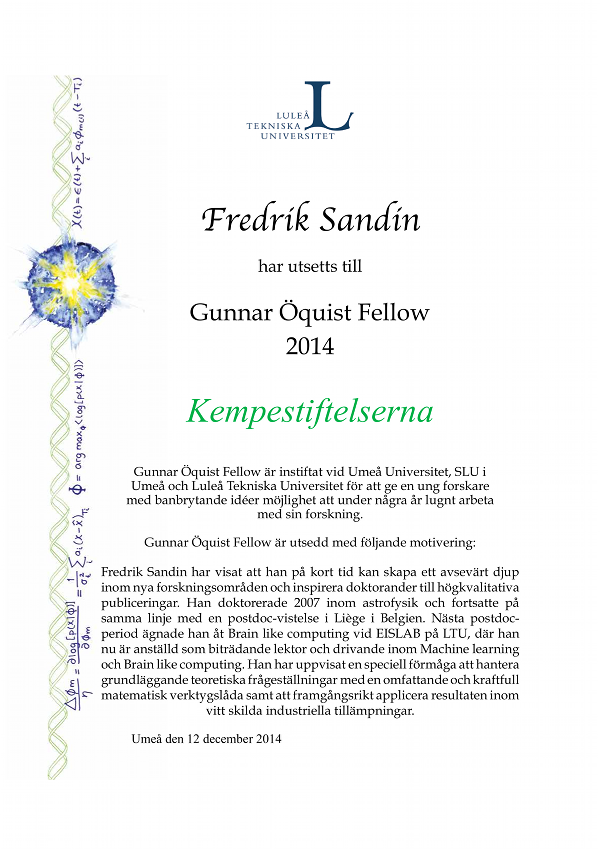
- Gunnar Öquist Fellowship award External link. and grant from The Kempe Foundations External link..
- Ubiquitous Cognitive Computing: A Vector Symbolic Approach (2014), first PhD thesis External link. I had the honour to supervise. Blerim worked on neurosymbolic and hyperdimensional computing in the early days of interoperability research and is now senior lecturer at Lund University External link.. His pioneering work inspired Evgeny External link. , Denis External link. and later Pedro External link. at LTU to work on hyperdimensional computing.
- Dark matter in neutron stars hypothesis with Paolo Ciarcelluti: Paper External link., paper External link., impact External link.. We showed that hidden sector dark matter candidates can modify the structure of neutron stars External link..
- ISSP award External link. for an Original Work in Theoretical Physics (note who signed the award: Prof. 't Hooft External link. and Prof. Zichichi External link. , and consider the level of the 1999 Nobel Prize External link.).
- Preon star hypothesis. Paper External link., paper External link., observational predictions External link., Nature news External link., Phys. Rev. Focus External link., New Scientist External link..
- Affiliated with WASP External link.. Member of ELLIS External link. and MODE External link..
Courses
Professional education (upskilling)
- Neuromorphic Computing External link., a navigational guide in the form of a 40 hour self-study course. Can be combined with D7064E (below) for in-depth knowledge.
Regular courses, 7.5 Hp/ECTS
- Programming for Machine Learning (D0036E External link.), introduction to Python and machine learning with scikit-learn.
- Neural Networks and Learning Machines (D7046E External link.), introduction to artificial and spiking neural networks, entry point for D7064E (below) or/and Advanced Deep Learning (D7047E External link.).
- Also available as a 3rd cycle course including an individual project (for Ph.D. students).
- Neuromorphic Computing (D7064E External link.), deepening course focusing on spiking neural networks and applications/principles of neuromorphic hardware.
- Also available as a 3rd cycle course including an individual project (for Ph.D. students).
- Programming for Scientific Computing (D7066E External link.), focuses on programming and software engineering concepts for scientific computing.
- Master thesis courses in Engineerng Physics and Electrical Engineering (X7010E External link., X7011E External link., X0003E External link.).
Since 2014, I am program director of the "Teknisk fysik och elektroteknik External link." program at LTU (Civilingenjör, 300Hp), co-directed with Andreas Almqvist External link.. We develop the program with, e.g., guidance from CDIO, an annual program workshop organized in June, student workshops, and study visits with the program council.
Lectures also in D0032 Introduction to AI External link. and D0028E Programming and Digitalization External link.. Was examiner for E0003E Electric circuit theory External link., D0011E Digital design External link., D0017E Introduction to programming for engineers External link.. Before 2010 I taught courses in physics, including lectures about mechanics, thermodynamics, waves, optics, quantum physics, and also some 3rd-cycle lectures in astrophysics, cosmology and quantum field theory at finite temperature (J. Kapusta's book).
Note on philosophy of teaching
The modern dogma of education, where intended learning outcomes guide the design of examination and time-aligned active learning/tutoring activities based on modularised digital content with exercises is quite effective. We use this approach systematically and strive to improve our methods. However, the main bottleneck in education and upskilling is inner motivation. Much like the central role of the observer has been mostly neglected in modern science and mathematics it appears to me like the educational system has focused disproportionately on quantifying learning instead of stimulating curiosity and individual development. The multicosts of multitasking External link. blends functional stupidity into a dangerous cocktail of discouragement and culture devastation. Motivation is key to entering the magic realms of STEAM (Science, Technology, Engineering, Arts, and Mathematics).
Background
MSc diploma work External link. in ATLAS at CERN (2001), starting with . PhD in Physics External link. (2007, LTU, Swedish Graduate School External link. of Space Technology) focusing on exotic phases of matter in neutron stars External link.. As a PhD student I received the “New-Talents” award  External link. for an original work in theoretical physics at the International School of Subnuclear Physics External link. in Erice, for work done with Johan Hansson External link.. My first postdoc was funded by FNRS and focused on computational and fundamental physics at IFPA External link. in Belgium (2008-2009).
A growing interest for the computational physics of brains and neuromorphic technologies made me shift research focus. I did a second postdoc in brain-like machine learning (2010-2011) at EISLAB, where I became assistant professor (until April 2016), associate professor (until March 2021) and presently work as professor in Machine Learning. I received a Gunnar Öquist Fellowship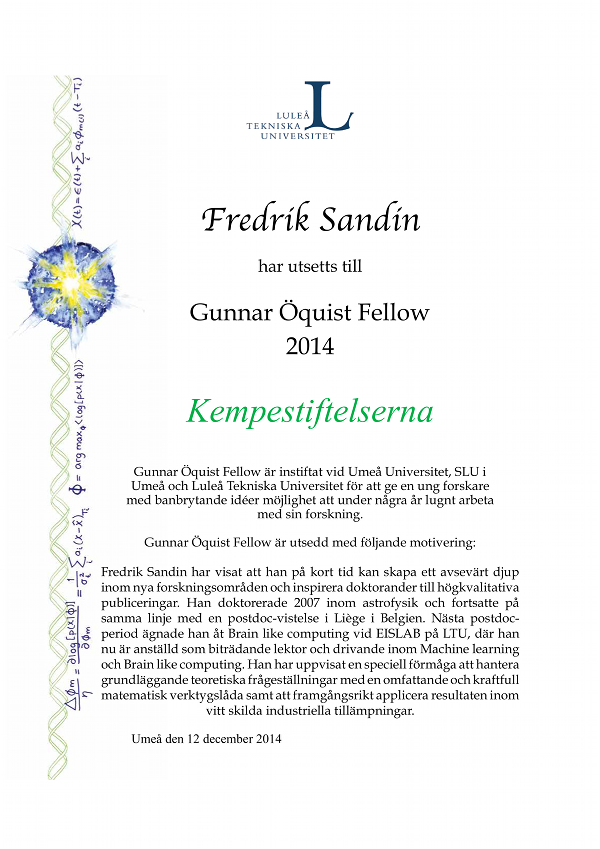 External link. by the Kempe Foundations in 2014, including mentoring by Gunnar and 3 MSEK for research. I served as a technical committee member of the SKF–LTU External link. University Technology Center, as a research theme leader (2013-2018) in the Intelligent Industrial Processes area of excellence, and as a member of the Applied AI Innovation Hub External link..
I also served in several faculty workgroups focusing on improving education processes.
I have acted as reviewer for top journals (like TNNLS, Neuromorphic Computing and Engineering, Physical Review, Frontiers in Neuroscience, Physical Review) and the European Commission; reviewer of fundamental science applications, e.g., for the Australian and Swedish Research Councils; reviewer of professor applications; reviewer of PhD theses; workshop organizer; program chair. I coordinated national and EU research proposals. Professional education include: Organisational health and leadership (2014), Previa AB; Intellectual property (2014), SKF European Patent Office; Docent qualification (2012), LTU; Media training (2011), Kalix Folkhögskola; Teaching and learning in higher education (2010), LTU; Project management (2009), Astrakan AB; Personal leadership (2006), Personal Management International (PMI).
Member of WASP External link. and ELLIS External link. since 2022 and MODE External link. since 2023.
Other
Older code and tools. Contact me if you are interested in code used in more recent articles that are not listed here or cannot be obtained due to broken links etc (refer to contact info above).
- 3FCS code, link External link. .This code was developed and used for the quark matter calculations in the papers about neutron stars with quark matter cores and related phase diagrams, including the highly cited paper in Phys. Rev. D. External link.
- Femtolensing tool, link External link. . Calculates the gravitational lensing signatures of low-mass (10^14 -10^17 kg) compact interstellar objects. This code was developed when working on the preon star hypothesis, see highlights below.
- N-dimensional random projection code, link External link. . Result of early work on representation learning for cognitive computing.
- CBVS code, link External link.. Early work on cognitive computing, related publications here External link. and here External link..
- Dircheck, link External link. . A useful tool for verification of file archives.
- Python code for distributed computing over ssh, link External link. .
- ASOUND Matlab plugin, link External link. .
- Online collaborative writing in Latex, link External link. . Developed before the era of Sharelatex / Overleaf etc.
Updated:
Published: