
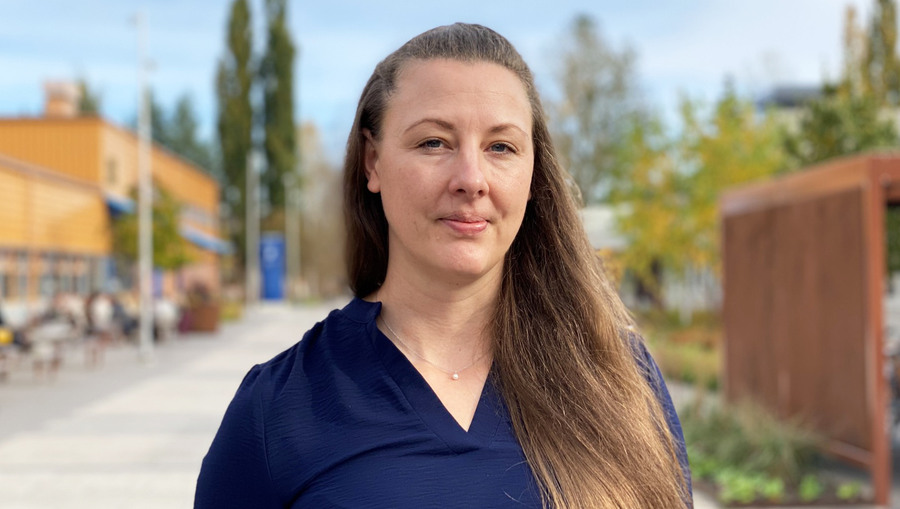
Linnéa Körlof, doctoral student in Occupational Therapy at Luleå University of Technology.
23 October 2026
Activities in everyday life can strengthen older adults social participation
Meaningful activities and the right support can help to support older adults social participation as their lives change. In a new doctoral thesis from Luleå University of Technology, Linnéa Körlof shows how older adults develop strategies for social participation and how occupational therapists can support this process through Health Web, a digital group intervention.
Older adults may experience a range of changes that affect their social participation, such as losing a loved one, moving home or changes in their own health or that of their partner or friends. In her doctoral thesis, Linnéa Körlof, doctoral student in Occupational Therapy at Luleå University of Technology, has investigated how older adults social participation can be supported as their circumstances change.
The research shows that social participation involves more than simply spending time with other people. It is also about using strategies to maintain maintaining important relationships and social roles through meaningful activities and feeling part of a wider community. Activities carried out alone can therefore also contribute to a sense of social participation.
In the first study of her thesis, Linnéa Körlof reviewed previous research which showed, among other things, how older people could experience social participation by watching football on television, even when sitting alone at home. Knowing that thousands of others were supporting the same team created a sense of belonging to a wider community. If football had also been a lifelong interest, perhaps as a player, coach or loyal supporter, the activity could help preserve a sense of identity in relation to others, even as life circumstances change.
Maintaining a sense of belonging is particularly important when life circumstances change. Older adults may benefit from receiving support for their social participation before they become at risk of isolation. Once someone becomes involuntarily isolated, it can be difficult to break that isolation, and previous research has shown that loneliness increases the risk of both mental and physical ill health.
"The earlier we offer support when people's life circumstances change, the better the opportunities we can create for older adults to maintain their social participation before loneliness and related health problems arise," says Linnéa Körlof.
Digital support for older adults social participation
Part of the research has involved further developing and testing Health Web, a digital group intervention led by an occupational therapist. The starting point for Health Web is older people's own experiences, priorities and goals. Through short digital video lectures and reflection assignments, participants explore which activities and social contexts are meaningful to them. Based on this, they can develop their own strategies for maintaining, adapting or finding new ways to participate socially as their lives change.
During the online group sessions, participants can share experiences, inspire one another and explore new opportunities together. The occupational therapist leads the sessions and creates opportunities for participants to reflect, exchange experiences and learn from one another.
"By reflecting on what matters in their everyday lives and learning from other people's experiences, older people can be supported in finding new ways to support their social participation," says Linnéa Körlof.
Health Web has been tested on a small scale within municipal services as part of the research and was perceived as valuable by both older participants and occupational therapists. It could also make support more accessible to people who find it difficult to attend in-person sessions. However, further evaluation and access to technical support are still needed.
Through interviews, self-assessments and group discussions, Linnéa Körlof has investigated how Health Web works and what conditions are needed to develop support for older people.
The findings can help occupational therapists and other professionals develop support that strengthens older people's opportunities to remain socially engaged. They also provide municipalities with knowledge about how preventive and health-promoting initiatives can become a routine part of health and social care.
Integrating new approaches into municipal services requires more than the commitment of individual staff members. The thesis shows that shared working practices, supportive organisational structures, a focus on health promotion and collaboration between healthcare, social care and other organisations in the community are needed. An important part of this is drawing on both older adults own experiences and occupational therapists' expertise to develop support tailored to individual needs.
Further research to develop and evaluate Health Web
The researchers now hope to continue developing and evaluating Health Web. The next steps include testing the intervention on a larger scale and investigating how older adults use their strategies over time. More knowledge is also needed about which groups of older may most from the intervention.
"My hope is that Health Web can eventually become part of expanded and improved support for older adults social participation within municipal services," says Linnéa Körlof.
Contact
Linnéa Körlof
- Lecturer
- 0920-493705
- linnea.korlof@ltu.se
- Linnéa Körlof
Published:
Updated: